
This post was first published in the Wonderverse Blog
Close your eyes and try to picture a scientist in your mind.
What were they like?
Were they male or female? What was the color of the skin? Were they heterosexual or homosexual? What was their hairstyle like? Did she or he have disabilities?
Science is a very successful collective endeavor that allows us to explore the most extraordinary and intricate aspects of nature. Yet, far from being an “objective” and “cold” process, the scientific process is a human activity of people who step into it with their passions, ideas, intuitions, but also prejudices and limits.
I have become more aware of the complex intertwining between biases and the advancement of science after watching the movie “Picture a scientist”. This Netflix documentary looks at the lives of three women scientists who share about their stories and scientific careers. What emerges is disturbing: sexual harassment, gender pay gap and lack of credit for their scientific work. Family leave still considered as a stigma. Women more likely to be ignored in meetings, etc. … the list goes on and on.
Though in recent years some progress has been made towards a more equal education in STEM disciplines (science, technology, engineering, and mathematics), women are still largely underrepresented in science. The recent round of Nobel prize winners has emphasized once again that great gender imbalance, as all seven winners in science this year were men.[i]
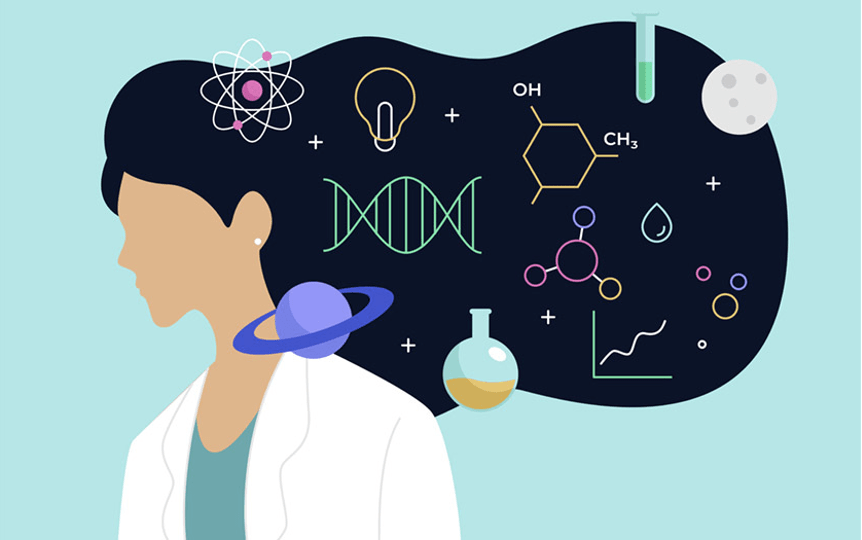
But let’s go back to our opening thought experiment. Seriously, how did you picture a scientist in your mind?
We tend to believe that our mental associations are largely determined by education, that the choices we make are shaped by our conscious vision of the world. Right?
The thing is, that our brain does not quite “think” that way. Harvard University’s implicit association test[ii], which is referred to in the film, was specifically devised to assess our implicit associations about race, gender, sexual orientation and other topics.
I decided to take the test myself, thinking that I would come out clean. I was wrong!
When doing the test, if we are given enough time to think about our associations, our decisions reflect our conscious beliefs. However, as the time at our disposal is cut to minimum, an uncomfortable truth emerges. Our brains do have deeply engrained implicit biases and that is something we all carry in our heads.
The test shows how statistically men tend to be associated more with technical and scientific professions, while women with more caring roles. Even really well-intentioned people tend to display those biases. The most difficult evidence to swallow is that these kinds of implicit associations seem to be engrained as much in men’s as they are in women’s brains.
It is a fascinating cultural as well as scientific problem. There is a lot inside our minds that we do not know about.
As we look at the intricate web of relationships in nature, our identities as scientists too are deeply intertwined in it and can be a source of wonder. In this respect, encouraging and protecting diversity in the research community is undoubtedly a point of strength for our society. We need to keep up our guards and be vigilant so that our choices reflect the core values upon which we want our future to be built.
But what do you think the steps are? Why don’t you share your thoughts with us in the comments below?
References
[i] Sanderson, Katharine. “Researchers voice dismay at all-male science Nobels.” Nature (2021).
 Water & Wine
Leave a comment