
I write this post from Barcelona (Spain) where I am attending an international scientific conference. The focus of the meeting is on artificial molecular assemblies wlth bio-applications. Often such artificial systems try to mimic shapes and functions of Nature with extraordinary results both in terms of technological application as well as aesthetic. I usually set aside also a little time to explore a bit about the city and the local culture. Being in Barcelona has been particularly special for me as I had desired to visit the sagrada familia for a very long time. Thls extraordinary masterpiece is fruit of the genius of Gaudi (1852-1926) who blended together in a unique way architectural elements with natural motives. It strikes me how Gaudi’s inspiration in mimicking nature through arts and architecture could one day have be attempted by scientists too at a nanoscale as I see at the conference following the work of my fellow scientists.
Back to the sagrada familia. There is something else which has really caught my imagination. The church is still under construction and its completion is expected to be 2026 to commemorate the centenary of Gaudi`s death. One of the things that have intrigued me the most about this extraordinary piece of art has to do with its central tower which will be dedicated to Jesus. It will be 172.5 metres tall, making it the tallest church in Europe, but just one meter shorter than the nearby Montjuic Mountain, to remind us – according to Gaudi – that man’s work cannot ever surpass Nature’s.
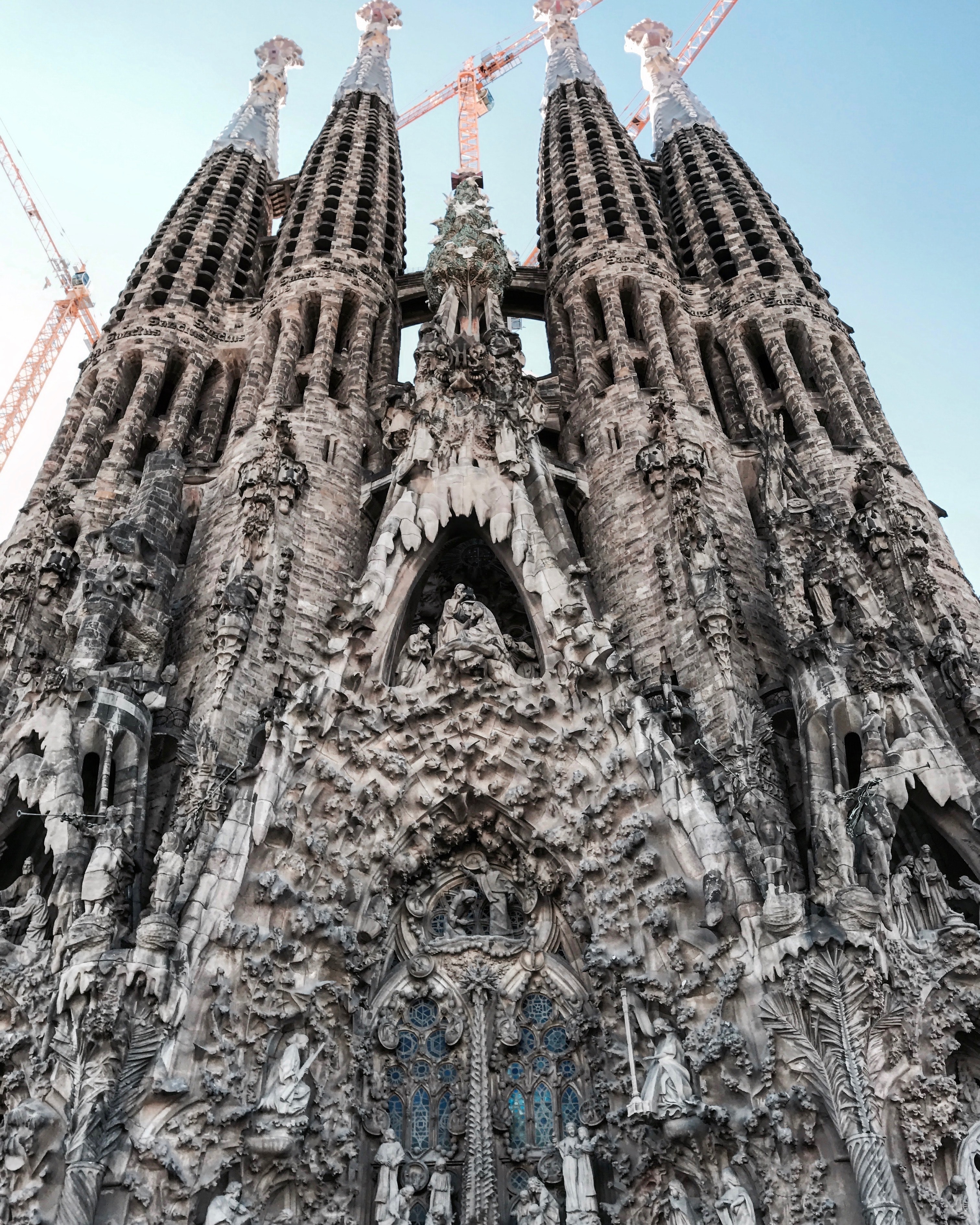
The architect in chief of the project, Jordi Fauli, has asked the Italian physicist Marco Bersanelli, to collaborate in the project of the central tower in order to realise with it a contemporary representation of the universe. However, the shape of the tower is very elongated and therefore very different from the classical spherical vaults which for centuries have been used to depict the starry sky in churches.
Contemporary physics though tells us that we should take time as well as space into consideration when we attempt to describe the shape of the universe. So, Prof Bersanelli has observed that the curvature of the tower resembles very closely that used by Friedmann and Lemaitre to describe the expansion of the universe. He suggests that the vault of the tower could represent the whole cosmic history, with the origin of time at its apex, and space expanding up from top to bottom, to reach our present at the base of the tower.
Gaudi could never had dreamt of such an interpretation of his project, but as I imagine myself already looking up the central tower of sagrada familia I cannot help but thinking of the fact that we as humans, so tiny and vulnerable in comparison to the huge and complex universe we are in, are that unique point in which reality becomes aware of itself. A small point that can wonder at the fact that it all exists, it is beautiful and worth exploring.
Il cielo in una torre
Scrivo questo post da Barcellona (Spagna) dove mi trovo ad una conferenza scientifica internazionale. Il tema dell’incontro e’ su sistemi molecolare artificiali con potenziali bio-applicazioni. Spesso tali sistemi provano a mimare le forme e le funzioni dei sistemi naturali con risultati straordinari sia in termini tecnologici che estetici.
Come spesso faccio quando viaggio anche questa volta ho dedicato un po’ di tempo ad esplorare la citta’ e la cultura locale. Essere a Barcellona per me e’ una cosa veramente speciale perche’ da tanto tempo desideravo visitare la sagrada familia. Questa straordinario e imponente opera d’arte e’ frutto del genio di Gaudi (1852-1926) che ha voluto fondere in modo unico elementi architettonici con motivi naturali. Mi colpisce come l’ispirazione di Gaudi di mimare la natura attraverso l’arte e l’architettura sia potuta un giorno essere tentata anche in campo scientifico in nanoscala come sto vedendo in questi giorni alla conferenza seguendo il lavoro dei miei colleghi…
Ma torniami alla sagrada familia. C’e’ qualcos’altro che ha colto la mia immaginazione. La chiesa e’ ancora in fase di costruzione e si aspetta la sua conclusione nel 2026 anno in cui si commemorera’ il centerio della morte dello stesso Gaudi. Una delle cose che mi ha piu’ colpito in questa opera d’arte straordinaria ha a che fare con la sua torre centrale che sara’ dedicata a Gesu’. Sara’ alta 172.5 metri, rendendola la chiesa piu’ alta d’Europa, ma appena un metro piu’ corta del vicino monte Montjuic, per ricordare – secondo Gaudi’ – che per quanto straordinarie le opere degli uomini siano non possono mai superare quelle della Natura.
L’artchitetto responsabile del progetto, Jordi Fauli’ ha chiesto al fisico italiano Marco Bersanelli di collaborare al progetto della torre centrale per realizzare con essa una rappresentazione contemporanea dell’universo. La forma della torre pero’ e’ molto allungata e quindi molto differente dalle classiche volte sferiche che per secoli sono state usate per descivere il cielo stellato nelle chiese.
La fisica contemporanea ci spinge pero’ a prendere in considerazione il tempo cosi’ come lo spazio per descrivere la forma dell’universo. E cosi’ il prof Bersanelli ha osservato che la curvatura della torre assomiglia molto a quella usata da Friedmann e Lemaitre per descrivere l’espansione dell’universo. Egli suggerisce che la volta della torre potrebbe rappresentare l’intera storia cosmica, con l’orgine dell’universo al vertice, e spazio e tempo che si espandono dall’altro verso il basso, per raggiungere il nostro presente alla base della torre.
Gaudi non poteva certo sognare una simile interpretazione del suo progetto, ma mentre mi immagino gia’ col naso all’insu a guardare la torre centrale della sagrada familia non posso non riflettere sul fatto che noi umani, sebbene minuscoli e vulnerabili in confronto all’enorme e complesso universo che ci ospita, siamo quel punto unico in cui la realta’ diventa cosciente di se stessa. Un piccolo punto – alla base di questa storia cosmica – che puo’ stupirsi al fatto che tutto questo esista, e che sia bello e degno di esplorazione.
 Water & Wine
Leave a comment